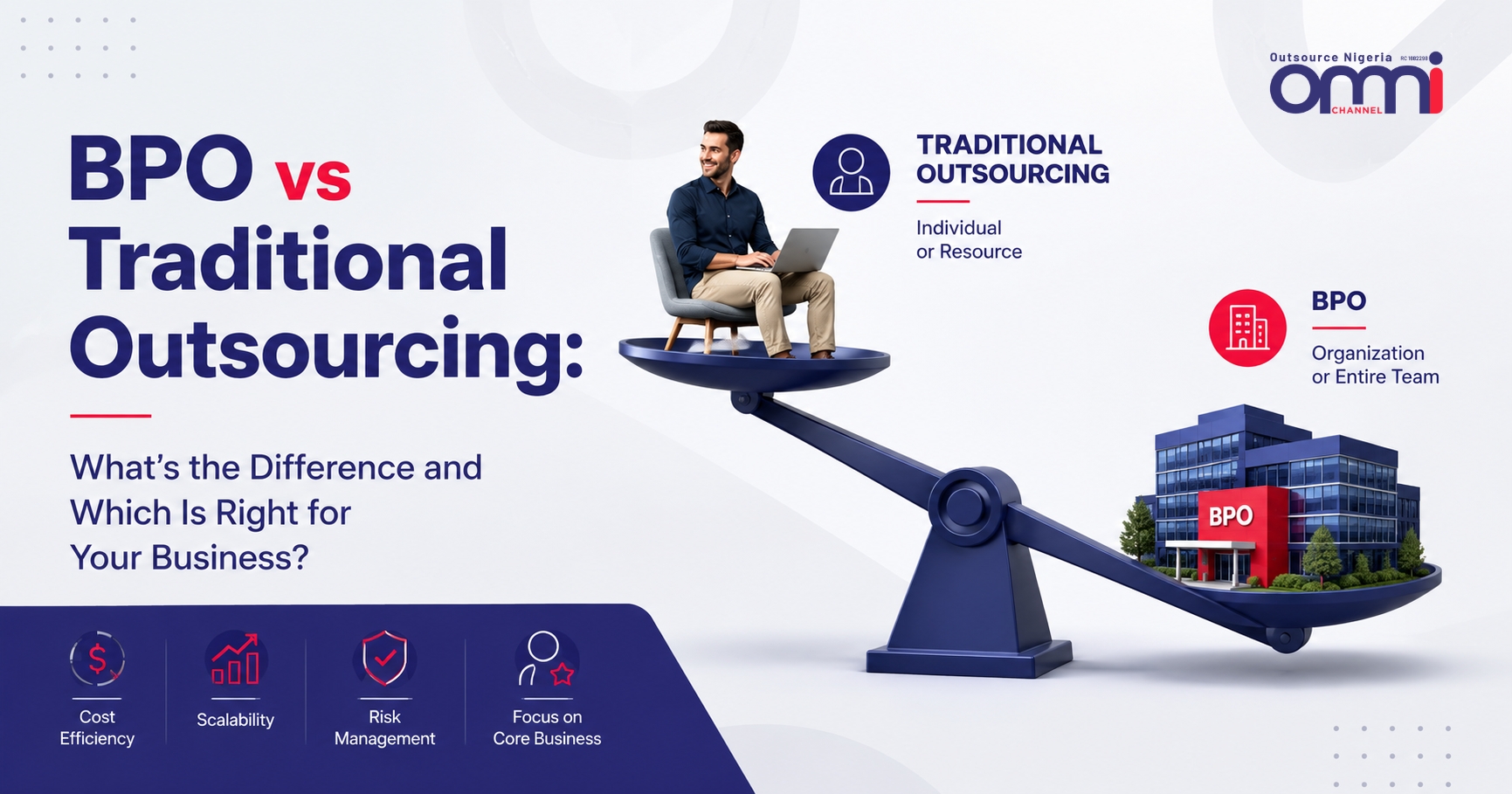
Many businesses mistakenly use the terms outsourcing and Business Process Outsourcing (BPO) interchangeably. This is a critical error. According to FasterCapital, BPO has become a cornerstone of modern business strategy, enabling companies to focus on core competencies while delegating non-core functions to specialized providers. While both models involve external partners, they solve fundamentally different challenges.
Choosing the wrong model can result in unnecessary costs, operational inefficiencies, and growth bottlenecks. Xometry notes that outsourcing generally refers to assigning specific tasks to external parties, while BPO involves structured management of entire business processes.
A company that needs a long-term operational solution may struggle if it relies solely on freelancers or project-based vendors. Likewise, a business that only needs a one-time project may overcomplicate things by pursuing a full outsourcing partnership.
If you’re new to Business Process Outsourcing, you may want to first read our guide on What Is BPO? where we explain how BPO works and why companies around the world use it to improve operational efficiency.
In this article, we’ll compare BPO and traditional outsourcing, explore when each model makes sense, and help you determine which approach is best for your business.
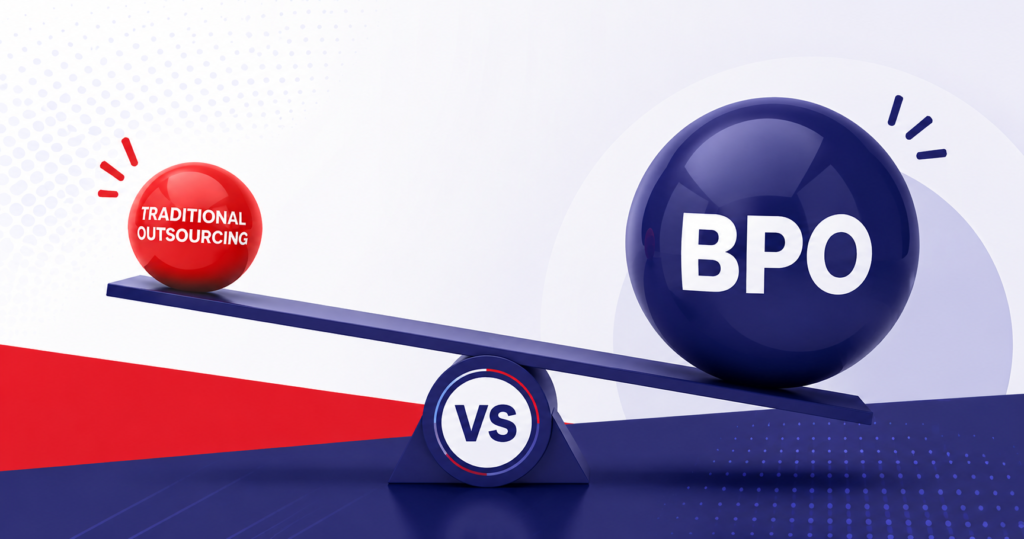
BPO vs Traditional Outsourcing at a Glance
| Feature | Traditional Outsourcing | Business Process Outsourcing (BPO) |
| Scope | Individual tasks or projects | Entire business processes |
| Duration | Usually short-term | Long-term partnership |
| Focus | Deliverables | Business outcomes |
| Integration | Limited | Deep operational integration |
| Management | Project-based | KPI and SLA-driven |
| Scalability | Limited | Highly scalable |
| Example | Hiring a freelance designer | Outsourcing customer support operations |
While both models involve external providers, the key difference lies in ownership. Traditional outsourcing focuses on completing a task. BPO focuses on managing a process.
That distinction affects everything from cost and scalability to governance and long-term business performance.
What Is Traditional Outsourcing?
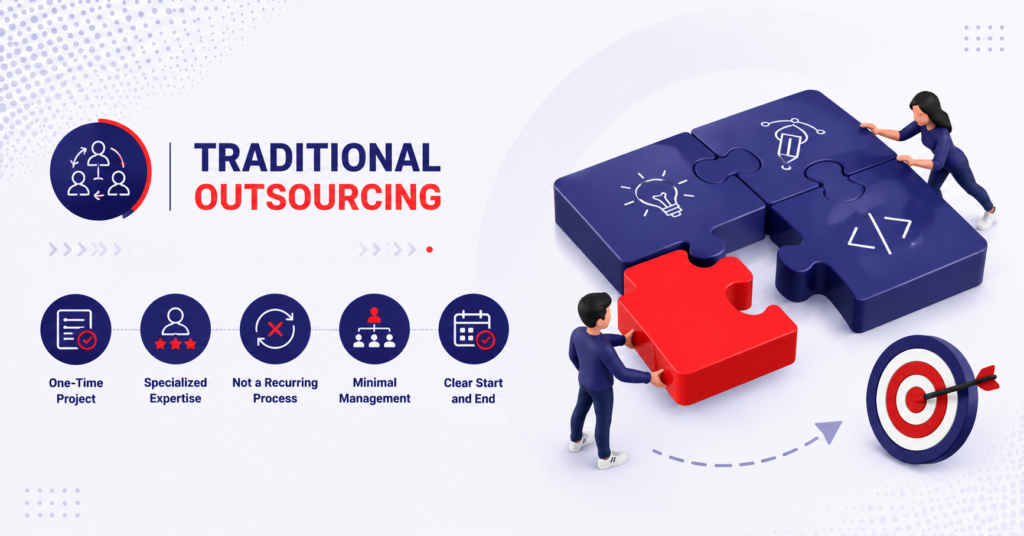
Traditional outsourcing involves hiring an external individual or company to complete a specific task, project, or specialized assignment.
The relationship is usually transactional. The business defines the scope of work, agrees on a timeline and budget, and receives the completed deliverable.
Common examples include:
- Website development
- Graphic design
- Content creation
- Video production
- Legal consulting
- Software development projects
In these situations, businesses typically require expertise that they either don’t possess internally or don’t need on a full-time basis.
Because the engagement is limited in scope, the provider usually operates independently and has minimal involvement in the company’s day-to-day operations.
Success is measured by straightforward questions:
- Was the work completed?
- Was it delivered on time?
- Did it meet expectations?
Deloitte notes that traditional outsourcing initiatives have historically focused on narrow, non-strategic activities — such as payroll processing — with the primary goal of reducing costs and improving efficiency.
For project-based work, traditional outsourcing remains one of the most efficient ways to access specialized talent without increasing permanent headcount.
WHAT IS BPO?
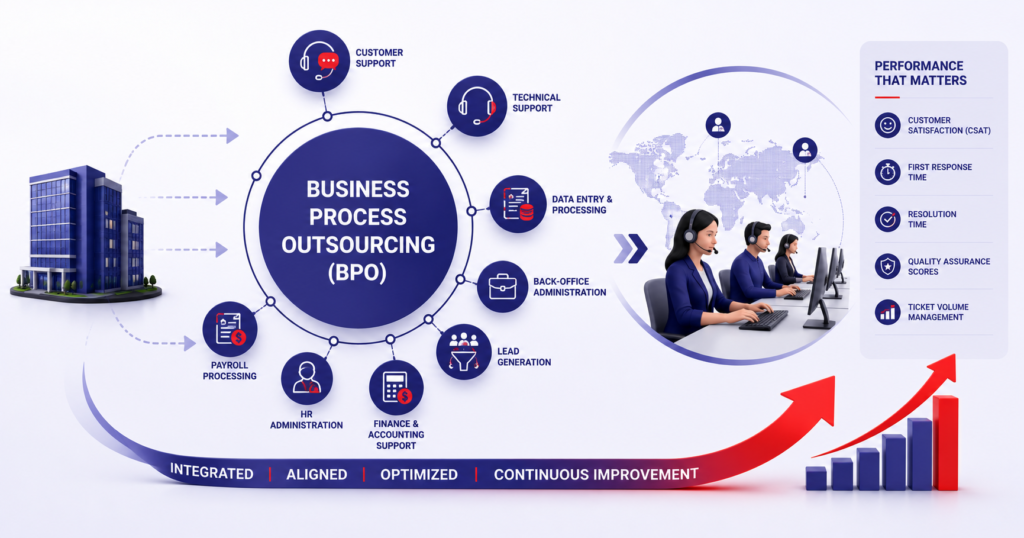
Business Process Outsourcing goes beyond completing individual tasks. Instead, a company transfers responsibility for managing an entire operational function to a specialized provider.
Examples include:
- Customer support
- Technical support
- Data entry and processing
- Back-office administration
- Lead generation
- Finance and accounting support
- HR administration
- Payroll processing
Unlike traditional outsourcing, BPO providers become integrated into a company’s workflows, systems, reporting structures, and operational objectives. Rather than measuring success based on completed deliverables, performance is measured using Service Level Agreements (SLAs) and Key Performance Indicators (KPIs).
For example, a customer support BPO provider may be evaluated on:
- Customer Satisfaction Scores (CSAT)
- First Response Time
- Resolution Time
- Quality Assurance Scores
- Ticket Volume Management
The focus is not simply on completing work but on continuously improving how the process performs. If you’d like a deeper explanation of how BPO works, its benefits, common services, types of BPO and real-world applications, read our complete guide:
What Is Business Process Outsourcing (BPO)?
Why the Difference Matters
At first glance, the distinction between outsourcing and BPO may appear minor. In reality, it has major implications for how businesses scale. When a company outsources a website redesign, the project eventually ends.
When a company outsources customer support, payroll administration, or back-office operations, the work never stops. These ongoing functions require staffing, quality control, reporting, training, process optimization, and performance management.
This is where many businesses encounter problems.They attempt to solve an operational challenge using a project-based outsourcing model.The result is inconsistent performance, fragmented workflows, and increased management burden.
Deloitte’s 2025 Business Process Outsourcing insights report stresses that outsourcing has evolved from a cost-reduction lever into a strategic enabler of transformation, flexibility, and innovation. Organizations that treat BPO as part of their broader operating model are better positioned to achieve resilience and scalability.
Similarly, Gartner distinguishes BPO from traditional outsourcing by noting that BPO is structured to manage entire business processes with performance-linked outcomes, while outsourcing is often limited to discrete tasks or projects. This difference is critical for companies seeking sustainable operational efficiency.
When Traditional Outsourcing Makes Sense
Traditional outsourcing is often the best choice when the work is temporary, specialized, or project-based. You should consider traditional outsourcing when:
- You need a one-time project completed
- You require highly specialized expertise
- The work is not part of a recurring business process
- Internal management requirements are minimal
- The deliverable has a clear start and end date
For example, hiring a designer to create a new brand identity or engaging a developer to build a mobile application are classic outsourcing scenarios. In these cases, the objective is straightforward: complete the project successfully and move on.
Accenture highlights that traditional outsourcing is most effective for discrete, well-defined projects where specialized expertise is required but ongoing operational support is unnecessary. This model allows businesses to access talent quickly, control costs, and maintain focus on core activities without long-term commitments.
When BPO Makes Sense
BPO becomes the better option when the work is ongoing, repeatable, and critical to business operations. You should consider BPO when:
- The function operates continuously
- The workload fluctuates throughout the year
- You need scalability
- Performance must be monitored consistently
- The process directly impacts customers or revenue
For example, managing customer support internally often becomes challenging as a business grows. New agents must be recruited, trained, supervised, and monitored. Technology systems must be maintained. Service quality must remain consistent.
A BPO provider already has the infrastructure, management systems, processes, and personnel required to handle these responsibilities. Instead of building everything internally, businesses gain immediate access to an operational engine that can scale alongside growth.
McKinsey & Company has noted that BPO enables firms to achieve scalability and resilience by leveraging specialized providers who can deliver consistent performance across fluctuating workloads — something traditional outsourcing models struggle to sustain.
Cost Considerations
Many companies initially assume traditional outsourcing is always the cheaper option. In reality, the answer depends on the nature of the work. Traditional outsourcing costs are usually tied directly to project completion. Businesses pay for a specific deliverable and move on.
BPO costs typically include:
- Service delivery
- Team management
- Reporting and analytics
- Quality assurance
- Technology infrastructure
- Process improvement
- Operational oversight
While the monthly investment may appear higher, businesses often gain capabilities that would otherwise require significant internal hiring, management, and infrastructure expenses.
The question should not be:
“Which option costs less?”
The better question is:
“Which option creates the greatest operational value?”
Potential Risks and How to Reduce Them
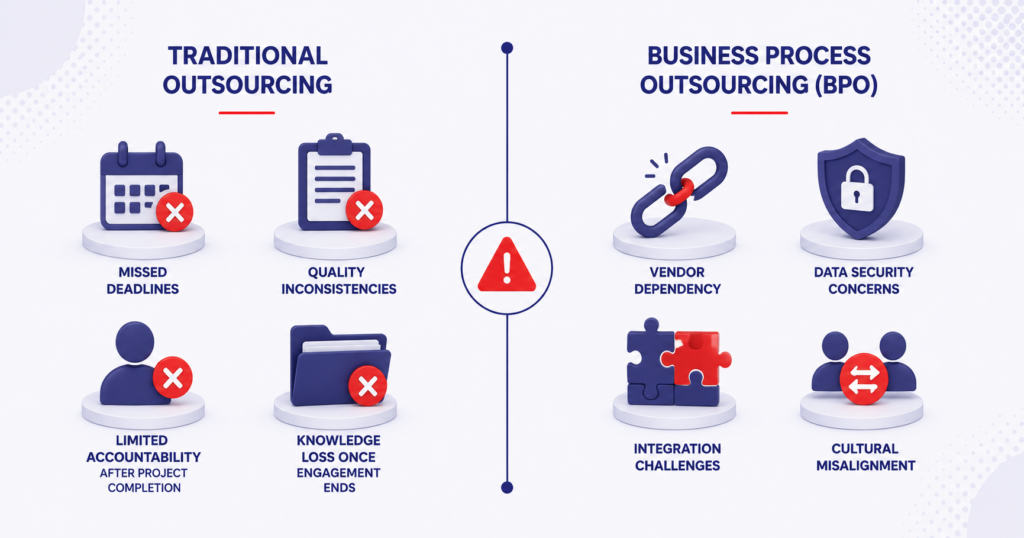
Both outsourcing models involve risk. Traditional outsourcing risks include:
- Missed deadlines
- Quality inconsistencies
- Limited accountability after project completion
- Knowledge loss once the engagement ends
BPO risks may include:
- Vendor dependency
- Data security concerns
- Integration challenges
- Cultural misalignment
These risks can be significantly reduced through careful vendor selection, clear service agreements, strong communication, and ongoing performance management. Businesses should also look for providers with established security practices, documented processes, and measurable performance standards.
How to Choose the Right Model
If you’re still unsure which approach fits your situation, ask yourself the following questions:
- Is the work ongoing? If yes, BPO is usually the stronger option.
- Does the function directly affect customer experience? If yes, BPO often provides greater long-term value.
- Is this a one-time project with a clear endpoint? If yes, traditional outsourcing may be sufficient.
- Do you need continuous improvement and performance reporting? If yes, BPO is likely the better choice.
A simple rule of thumb is this:
If you’re outsourcing a task, choose traditional outsourcing. If you’re outsourcing a function, choose BPO.
Final Thoughts
Traditional outsourcing and BPO both solve real problems—but they solve different problems. Outsourcing is the right choice when you need a specialist to finish a defined project. BPO is the right choice when you need a partner to own, optimize, and scale an ongoing process.
As your business grows, the question shifts from who can do the work to who can own and improve the process. Choosing the right model reduces hidden costs, improves customer experience, and unlocks scalable capacity.
Looking for a BPO Partner?
Outsource Nigeria helps growing businesses build and manage scalable operational systems across customer support, back-office administration, data processing, lead generation, payroll, and finance operations. We don’t just provide staff—we help structure and run processes that can scale without increasing internal complexity.
Whether you’re exploring outsourcing or ready to transition into a full BPO model, we start by understanding your workflow, defining key KPIs, and recommending the right engagement model—starting with a low-risk pilot or a structured project.