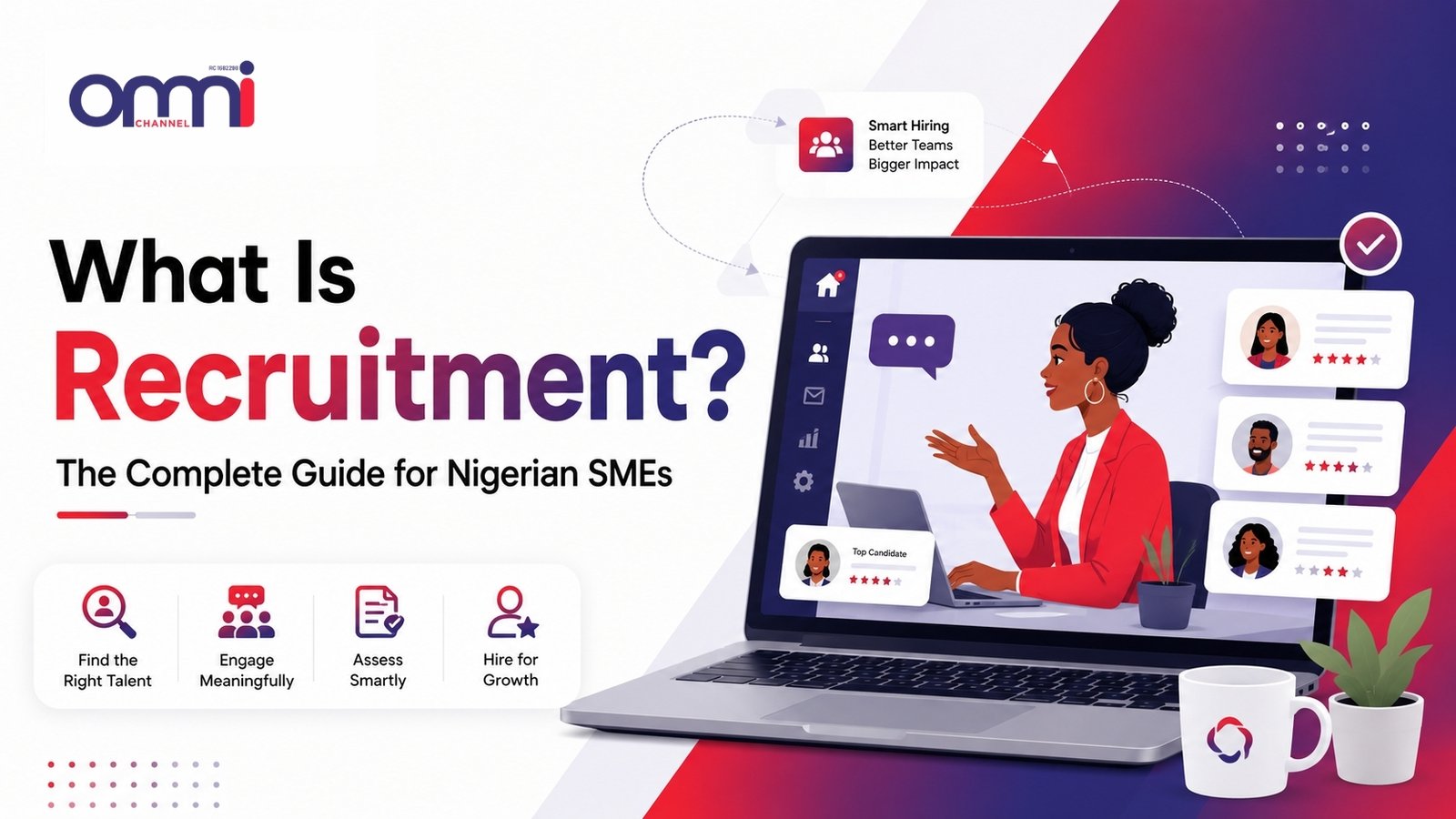
Recruitment is one of the most important processes for Nigerian SMEs, because it determines how businesses build the capacity to grow. When a business grows, there usually comes a point when the founder can no longer do everything personally. Customer enquiries increase, operations become more complicated, and the team needs more support to keep up with demand.
But hiring more people does not automatically solve a capacity problem. A business can add employees and still experience poor customer service, slow delivery, overwhelmed managers, or an owner who remains involved in every decision.
This is why recruitment is more than posting a job vacancy or finding someone who is available to start immediately. The goal is to identify the skills and capabilities a business needs and find people who can help the organisation achieve its current and future objectives. The Chartered Institute of Personnel and Development (CIPD) similarly describes good recruitment as securing the skills and abilities needed for both current and future organisational needs. CIPD — Recruitment: An introduction
For Nigerian SMEs, this becomes particularly important as businesses grow without necessarily having dedicated HR or talent acquisition teams. The founder or manager may still be responsible for writing job descriptions, reviewing CVs, interviewing candidates and making the final hiring decision.
So, the real question is not only “What is recruitment?” It is “How can recruitment help a business build the people and capacity it needs to grow?”
What Is Recruitment?
Recruitment is the process of identifying, attracting, assessing and selecting qualified candidates for roles within an organisation. It typically begins when a business identifies a workforce need and continues through sourcing, screening, assessment, interviews and selection.
SHRM describes recruitment as a structured process for finding, attracting, evaluating and hiring employees, with activities such as sourcing candidates, screening applications, conducting assessments and interviews, verifying qualifications and making offers. SHRM — A Step-by-Step Guide to the Recruitment Process
However, recruitment should begin with the business problem, not the job advert. If a Lagos-based business is struggling because the founder spends hours answering routine customer enquiries, the answer might be a customer service hire, better systems, automation, outsourcing, or a combination of these.
This is why effective recruitment is about finding the right capacity for the business, rather than simply increasing headcount.
Why Is Recruitment Important?
People are responsible for turning business strategies into actual results. A company can have a strong product and ambitious growth plans, but those plans still require people with the skills to execute them.
Research from McKinsey shows why the quality of talent can matter significantly, particularly in complex roles. Its research reports that high performers can be substantially more productive than average performers, with the difference reaching up to eight times in highly complex occupations. McKinsey — Attracting and retaining the right talent
The lesson is not that one “perfect” employee will solve every business problem. It is that recruitment decisions can affect productivity, customer experience, management workload and the organisation’s ability to execute its strategy.
For an SME, hiring the wrong person can create additional costs through poor performance, repeated recruitment, management time and disruption. Hiring the right person, however, can remove a bottleneck and give the business capacity to do more.
How SMEs Can Find the Right People
Recruitment processes differ between organisations, but the core stages are broadly similar. A practical recruitment process looks like this:
1. Identify the Need
Start by understanding why the business needs someone. The problem could be growing demand, an overloaded team, a skills gap, a new business function or a vacancy created by an employee leaving.
Before hiring, ask whether the problem could instead be solved through process improvement, automation, outsourcing or temporary support. This prevents businesses from hiring simply because everyone feels busy.
2. Define the Role
Once the need is confirmed, clearly define what the person will be responsible for. The role should cover responsibilities, required skills, expected outcomes, reporting structure, working arrangement and compensation.
A strong job description should explain what the person needs to achieve, rather than simply listing every task they might be asked to perform. This also gives candidates and hiring managers a clearer basis for evaluating suitability.
3. Attract Candidates
The business then decides where suitable candidates are most likely to be found. Depending on the role, this might include job boards, LinkedIn, employee referrals, recruitment agencies, professional communities, universities or direct sourcing.
The objective is not necessarily to receive the largest number of applications. It is to attract candidates who have a realistic match with the role and its requirements.
4. Screen and Shortlist
Applications are reviewed against the requirements established for the role. Screening should focus on evidence of relevant skills and experience rather than simply choosing candidates with the longest CVs.
5. Assess Candidates
Where appropriate, practical assessments or work samples can provide additional evidence of capability. A designer might complete a design task, a customer service candidate might respond to a simulated complaint, and a salesperson might participate in a sales scenario.
SHRM’s current recruitment guidance includes candidate assessments, work samples, structured interviews and qualification checks as parts of the selection process. SHRM recruitment process guide
6. Interview
Interviews give employers an opportunity to evaluate candidates against the requirements of the role. Structured interviews, where candidates are assessed against consistent criteria, can make the process more systematic and reduce decisions based entirely on personal impressions.
7. Verify and Select
Depending on the position, the organisation may verify qualifications, references or other relevant information before making a final decision. The successful candidate then receives an offer outlining the role and employment terms.
8. Onboard
Recruitment should connect directly to onboarding because accepting an offer is not the same as becoming productive. New employees need the information, tools, training and expectations required to understand their responsibilities and contribute effectively.
What Are the Main Types of Recruitment?
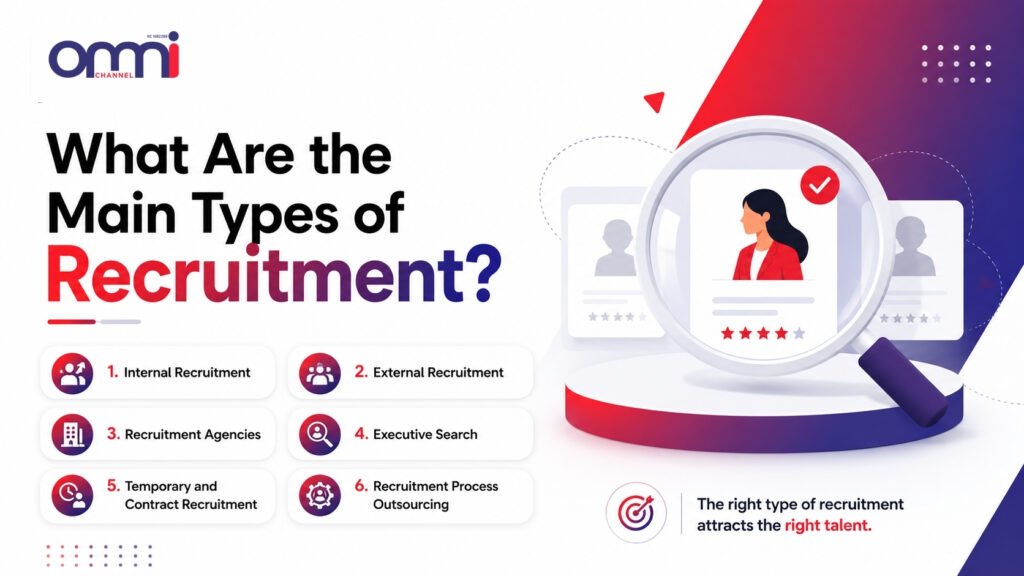
Recruitment can take different forms depending on the organisation’s needs, the role and the resources available.
Internal Recruitment
Internal recruitment involves filling a position with someone who already works within the organisation. It can be useful when the business has employees who understand its processes and are ready to take on greater responsibility.
External Recruitment
External recruitment involves looking outside the organisation for candidates. It can help businesses access skills, experience and perspectives that are not currently available within the team.
Recruitment Agencies
A recruitment agency supports businesses by sourcing and evaluating candidates for specific positions. This can be useful for companies that lack internal recruitment capacity or need help accessing specialised talent.
Executive Search
Executive search focuses on senior or highly specialised positions. Instead of relying only on applications, search firms may proactively identify and approach suitable candidates.
Temporary and Contract Recruitment
Temporary or contract recruitment provides people for a defined period, project or business requirement. It can be useful when demand is seasonal or when a business needs specialist support without making a permanent hire.
Recruitment Process Outsourcing
Recruitment Process Outsourcing (RPO) involves an external provider managing some or all of a company’s recruitment activities. Depending on the arrangement, this can include sourcing, screening, recruitment technology, interview coordination, candidate communication and recruitment reporting.
For growing SMEs, RPO can provide recruitment capability without requiring the business to build a large internal recruitment team.
Recruitment vs Hiring vs Talent Acquisition
These terms are related but describe different parts of the broader workforce process.
| Term | Meaning | Main Focus |
| Recruitment | Finding, assessing and selecting candidates | Meeting workforce needs |
| Hiring | Formally employing a selected candidate | Completing the employment decision |
| Talent Acquisition | Building a longer-term approach to attracting and developing talent | Future workforce capability |
For example, when a company searches for candidates for an open sales position, it is recruiting. When it selects a candidate and formally employs them, it is hiring.
Talent acquisition takes a broader and longer-term view by considering how the organisation will continually attract, develop and retain the talent it needs. This is why recruitment can be part of a wider workforce strategy rather than a process that only begins when a vacancy appears.
Why Recruitment Matters for Nigerian SMEs
Recruitment in Nigeria takes place within a labour market where businesses can face challenges matching available skills with employer requirements. The ILO has identified skills mismatches and weaknesses in labour-market matching as ongoing challenges in Nigeria, highlighting the importance of improving how skills and employment opportunities are connected. ILO — Assessment of Public Employment Services in Nigeria
For SMEs, this means recruitment should not focus exclusively on finding candidates who have already performed the exact same job. Businesses may also need to consider practical ability, transferable skills, learning capacity and whether the candidate can develop into the role.
The OECD similarly notes that business growth can require SMEs to develop or access broader skills in areas such as project management, finance, commercial activity and strategic thinking. OECD — Strengthening SMEs and Entrepreneurship for Productivity and Inclusive Growth
This is particularly important for founders who have built a business around their own expertise. As the company grows, the organisation may need skills that the founder does not personally possess, making recruitment an important part of building organisational capacity.
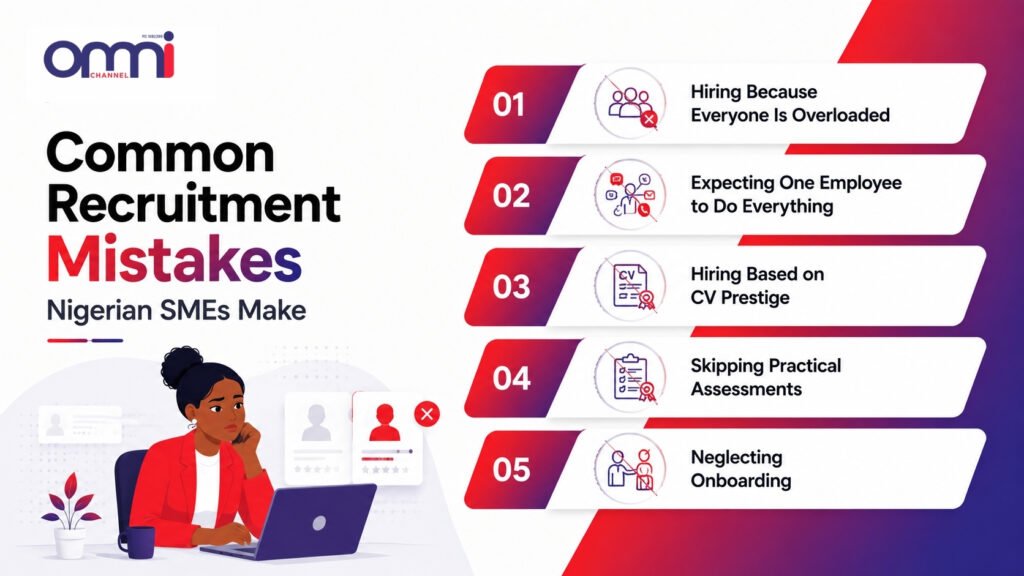
Common Hiring Pitfalls to Avoid
Recruitment problems often begin before a vacancy is even advertised. Some of the most common mistakes include:
1. Hiring Because Everyone Is Overloaded
When a team is overwhelmed, it can be tempting to hire the first person who appears available. A better approach is to identify the specific capacity problem and determine what type of role would actually solve it.
2. Expecting One Employee to Do Everything
Some SMEs combine customer service, administration, sales, accounting and social media into a single position. This can make the role difficult to fill and even harder for one person to perform effectively.
3. Hiring Based on CV Prestige
A candidate who worked for a large company is not automatically the right person for a smaller business. SMEs should consider demonstrated capability, adaptability and whether the candidate can succeed in the organisation’s actual working environment.
4. Skipping Practical Assessments
Interviews do not always show how someone will perform the actual work. Where appropriate, work samples or practical assessments can provide stronger evidence of capability.
5. Neglecting Onboarding
Even a strong hire can struggle if the business provides unclear expectations, insufficient training or limited support. Recruitment should therefore connect with a deliberate onboarding process.
How Do You Know Your Recruitment Process Is Broken?
A recruitment process may need attention when the same roles remain vacant repeatedly, new employees leave shortly after joining, managers regularly complain about poor-quality hires, or the founder has to personally manage every recruitment decision. Other warning signs include unclear job descriptions, inconsistent interviews and hiring that only begins once a vacancy has become an emergency.
These problems suggest that recruitment is being handled reactively rather than strategically. The solution might be a better recruitment process, stronger role definition, improved assessment, outsourcing or a different workforce strategy.
Recruitment Is More Than Filling Vacancies
A traditional approach to recruitment looks like this:
Someone leaves → Post a vacancy → Collect CVs → Interview → Hire.
A stronger approach starts much earlier:
Business strategy → Capacity requirements → Workforce planning → Recruitment → Onboarding → Performance → Growth.
This approach changes the purpose of recruitment. Instead of simply increasing headcount, the goal becomes building the human capacity required to execute the business strategy.
The OECD’s research reinforces this connection, noting that SME growth often requires businesses to access new skills and strengthen management capabilities as their organisations become more complex. OECD — Enabling SMEs to Scale Up
When Should a Business Consider Recruitment?
A business should consider recruitment when there is a clear and recurring capacity or skills gap that cannot be reasonably solved through better processes, technology, outsourcing or redistribution of existing responsibilities.
For example, a growing company may need a customer service employee because enquiry volume consistently exceeds the team’s ability to respond. Another business may need a specialist because it is pursuing an opportunity that requires skills nobody currently has.
The important question is not simply “Are we busy?” It is “What capability does the business need that it does not currently have?”
That question leads to better hiring decisions because it connects recruitment directly to the organisation’s operational needs.
Final Thoughts: Recruitment Builds Business Capacity
So, what is recruitment? At its simplest, it is the process of finding and selecting people for roles, but for a growing business, recruitment is much more than filling vacancies.
Recruitment is how a business builds the human capacity required to execute its strategy, serve customers and grow.
For Nigerian SMEs, this means recruitment should be approached as a business decision rather than an administrative task. The right people can strengthen operations, reduce bottlenecks and give a growing company the capacity to pursue opportunities without placing every responsibility on the founder.
At OmniChannel, recruitment forms part of a broader approach to helping businesses build operational capacity. Through recruitment, outsourcing, BPO and customer experience solutions, businesses can access the people and support they need while focusing their internal resources on growth.
If your business is struggling to find the right talent, spending too much time managing recruitment internally, or repeatedly hiring for the same roles, it may be time to rethink your recruitment strategy.
Talk to OmniChannel about building a more reliable recruitment and workforce solution for your business.