A business can handle thousands of customer interactions every month and still struggle to answer a simple question:
Are customers actually having a good experience?
Complaints can reveal individual problems. Sales figures can show whether customers are buying. But neither tells the full story of what customers experience across calls, chats, emails, purchases, support requests and other touchpoints.
That is where customer experience (CX) metrics become useful.
Metrics such as Customer Satisfaction Score (CSAT), Net Promoter Score (NPS), and Customer Effort Score (CES) give businesses different ways to understand what customers think, feel and experience with their company. They are not interchangeable, however. Each answers a different question.
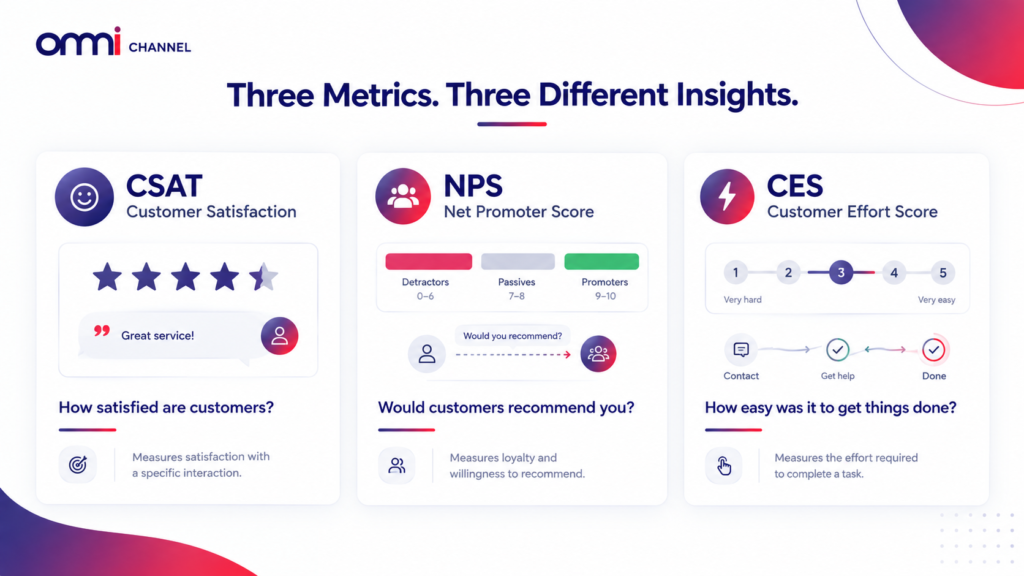
CSAT measures whether a customer was satisfied with a particular interaction. NPS measures willingness to recommend and provides a broader relationship signal. CES measures how easy or difficult it was for the customer to complete a task or resolve an issue.
The value comes from understanding what each metric tells you and connecting the result to what is actually happening in your customer operations.
What Are CX Metrics?
CX metrics are measurements used to understand and evaluate different aspects of a customer’s experience with a business.
They can capture things such as satisfaction, loyalty, effort, response times, resolution quality and other aspects of the customer journey.
The important question is not simply, “Which CX metric should we use?”
It is:
“What are we trying to understand about the customer experience?”
If the question concerns satisfaction after a support interaction, CSAT may be appropriate. If the business wants to understand the broader customer relationship, NPS can provide a different signal. If the goal is to identify friction in a particular process, CES can help reveal how difficult the experience was.
This is why treating one number as a complete measure of customer experience can create a misleading picture.
The Three Core CX Metrics: CSAT, NPS and CES
- CSAT: Are Customers Satisfied with This Interaction?
Customer Satisfaction Score (CSAT) measures how satisfied customers are with a specific product, service, interaction or experience.
A typical CSAT question is:
“How satisfied were you with the service you received?”
A common approach uses a 1-to-5 scale, from very dissatisfied to very satisfied. CSAT is usually reported as the percentage of respondents selecting the positive responses, commonly 4 or 5.
For example, if 80 out of 100 respondents select 4 or 5, the CSAT score is 80%.
Qualtrics’ guide to CSAT explains that CSAT is commonly used to measure satisfaction with a particular interaction, product or service.
The strength of CSAT is its specificity. A business can ask for feedback immediately after a customer contacts support, completes an order or receives a service.
But that specificity is also its limitation. A customer can be satisfied with one interaction while still having broader frustrations with the company.
A strong CSAT score therefore tells you something important about the measured experience, but it does not necessarily describe the entire customer relationship.
- NPS: Would Customers Recommend Your Business?
Net Promoter Score (NPS) is designed to measure customer advocacy/loyalty through a question such as:
“How likely are you to recommend this company or product to a friend or colleague?”
Customers respond on a 0-to-10 scale. Bain’s explanation of the Net Promoter System and NPS calculation classifies respondents into three groups:
- Promoters: ratings of 9 or 10
- Passives: ratings of 7 or 8
- Detractors: ratings of 0 to 6
NPS is calculated by subtracting the percentage of Detractors from the percentage of Promoters.
For example:
60% Promoters – 20% Detractors = NPS of +40
NPS provides a broader relationship signal than a transactional satisfaction score. It can help organizations track customer advocacy and changes in how customers perceive their relationship with the business over time.
However, the score does not automatically explain why customers responded the way they did.
A low NPS could be associated with issues involving service, product quality, pricing, communication or other parts of the customer experience. Follow-up questions and operational data are therefore important when interpreting the result.
- CES: How Easy Was the Experience?
Customer Effort Score (CES) Instead of asking whether customers were satisfied or whether they would recommend the business, CES measures how easy or difficult it was for a customer to complete a task, resolve an issue, obtain an answer or interact with a business.
A survey might ask:
“How easy was it to resolve your issue today?”
or:
“How easy was it to complete your purchase?”
CES can use different question formats and scales. Qualtrics, for example, documents both 1-to-5 and 1-to-7 CES implementations in its customer journey measurement tools. Its Customer Effort Score explanation describes CES as a measures the amount of effort a customer has to exert to resolve an issue, fulfil a request, make a purchase, complete another task or get a question answered.
CES is particularly useful for identifying friction.
Imagine a customer eventually gets a billing problem resolved, but only after making three calls, repeating the same information to different agents and waiting several days for an answer.
The customer may be satisfied with the final resolution. But the journey itself required unnecessary effort.
CES helps make that distinction visible.
CSAT vs NPS vs CES: What Does Each Metric Tell You?
| Metric | Core Question | Primary Focus | Useful For |
| CSAT | How satisfied were you? | Satisfaction with a specific experience | Measuring interactions, products, services, purchases, deliveries and other touchpoints |
| NPS | How likely are you to recommend us? | Customer advocacy and broader relationship signal | Relationship and loyalty tracking and customer feedback programmes |
| CES | How easy was it? | Customer effort and process friction | Identifying difficult processes and interactions. Issue resolution, self-service, checkout and other specific journeys |
The three metrics answer different questions.
CSAT tells you how satisfied the customer was. NPS tells you about their willingness to recommend. CES tells you how much effort the experience required.
That difference is more useful than trying to determine which metric is universally “best.”
Why Businesses Should Not Rely on One CX Metric
Consider a customer who contacts a company about an incorrect invoice.
The agent resolves the problem correctly, so the customer gives the interaction a 5/5 CSAT score.
However, the customer had to navigate a confusing phone menu and wait twenty minutes before reaching an agent. They therefore give a poor CES score because resolving the issue required significant effort.
Later, if similar billing problems continue, the customer may also give a low NPS score because their broader experience with the company has deteriorated.
These scores do not contradict one another.
They are measuring different parts of the experience.
Looking only at the positive CSAT score could hide the friction in the process and the recurring operational problem behind the customer’s experience.
It is also important to remember that CSAT, NPS and CES are only part of a broader CX measurement system. Other operational indicators, such as response time, first-contact resolution, repeat contacts, escalation rates and channel performance, can help explain what is happening behind the survey results.
CX Metrics in Contact Centre Operations
This is where CX measurement becomes more than a survey exercise.
In a contact centre, a customer experience score can be connected to the operational events surrounding the interaction.
For example, a low CSAT score may require looking at the customer’s wait time, the number of transfers, the issue category, the agent or team involved, whether the problem was resolved on the first contact, and whether the customer had contacted the business previously.
A poor CES score can similarly point toward unnecessary transfers, repeated explanations, unclear processes, limited self-service options or fragmented information between channels.
This operational context matters because the survey tells you what the customer experienced, while interaction data can help investigate what may have caused it.
Omni Channel’s call centre solutions are built around customer interactions across areas such as inbound customer service, issue resolution, customer satisfaction surveys and social media customer service. This is the operational environment in which CX metrics can become connected to the interactions that produce them.
The objective is not simply to collect more scores. It is to understand the operational conditions behind those scores.

The Bigger Question: What Do You Do With the Data?
Collecting customer feedback is relatively easy. Acting on them is harder.
A company can survey thousands of customers and still fail to improve the customer experience if the results never reach the teams responsible for the underlying problems.
For example, consistently low CES scores around a particular process could indicate unnecessary steps, poor communication, long wait times or disconnected customer-service workflows.
Similarly, falling CSAT scores after a product or policy change may signal a problem that needs further investigation. A score can identify a relationship signal, but qualitative feedback and operational information are needed to understand the reasons behind it.
The metric is therefore only the starting point.
The real value comes from connecting customer feedback to people, processes, systems and operational decisions. A practical CX measurement system therefore connects four things: customer feedback, interaction history, operational performance and action.
This is especially important in contact centre environments, where customer interactions generate information across calls, emails, chats and social channels. Omni Channel’s Customer Experience Solutions focus on customer interactions across channels including phone, email, live chat and social media.
Likewise, a centralized CRM can support this by connecting customer records with interaction history, support activity and other operational information. Omni CRM, for example, provides a centralized view of customer information, communication history, activities, sales opportunities, projects and support tickets, helping teams access more complete customer context from one workspace.
The technology does not replace CX measurement. It can help businesses capture, organize and act on the information those measurements produce.
The final step is closing the feedback loop.
A metric should not simply appear on a dashboard and disappear into a monthly report. It should help the responsible team identify a problem, investigate the cause and determine what needs to change.
How to Build a Useful CX Measurement System
Start with the customer journey, not the metric.
First, identify the specific experience you want to understand. Then choose the metric that matches the question.
If you want to know whether customers were satisfied with a support interaction, CSAT may be appropriate. If you want to understand the broader customer relationship and willingness to recommend, NPS may provide the relevant signal. If you want to identify friction in a particular process, CES can help.
Next, connect the feedback to operational data.
A score becomes more useful when you can investigate what happened around it. In a contact centre, that might include wait time, transfers, repeat contacts, resolution rates, escalation patterns and the channel through which the customer contacted the business.
Finally, act on the findings.
If customers consistently report high effort, investigate the process creating that effort. If satisfaction declines around a particular interaction type, examine the workflow, training, information available to agents and customer journey involved.
The goal is not to produce a perfect score.
The goal is to make customer experience easier to understand and easier to improve.
Conclusion
Good CX measurement is not about collecting the largest number of survey responses or chasing the highest possible score.
It starts with asking the right question at the right point in the customer journey.
CSAT measures satisfaction. NPS provides a broader signal of customer advocacy and relationship strength. CES reveals how much effort customers experience when completing a task or resolving an issue.
Used together with operational data, these metrics can help businesses move beyond knowing that customers are dissatisfied to understanding where the experience is breaking down.
For contact centre operations, that means looking beyond the score to the interaction behind it: the channel, process, wait time, transfers, resolution, agent workflow and customer history.
That is where CX measurement becomes more than a dashboard.
It becomes a tool for improving how the business actually serves its customers.