A company can provide excellent customer service and still deliver a poor customer experience.
A customer may speak to a polite support agent but struggle to find information on the website. They may receive a quick response on WhatsApp, only to repeat the same information when they call. They may complete a purchase easily but face weeks of confusion when trying to resolve an issue.
The problem is that customer experience is not created by one conversation or one department. It is shaped by how well a business connects its people, processes, technology and customer-facing channels around the customer’s journey.
This guide explains what customer experience means, how it differs from customer service, where CX problems occur, how to measure them and what businesses can do to improve the experience without simply adding more technology.
What Is Customer Experience?
Customer experience (CX) is the overall perception a customer forms from their interactions with a business before, during and after a purchase.
Gartner’s customer experience management guidance describes CX as the perceptions and feelings created by the one-off and cumulative effect of interactions with a supplier’s employees, systems, channels, products and services.
That definition matters because it shows why CX cannot be assigned entirely to the customer service team.
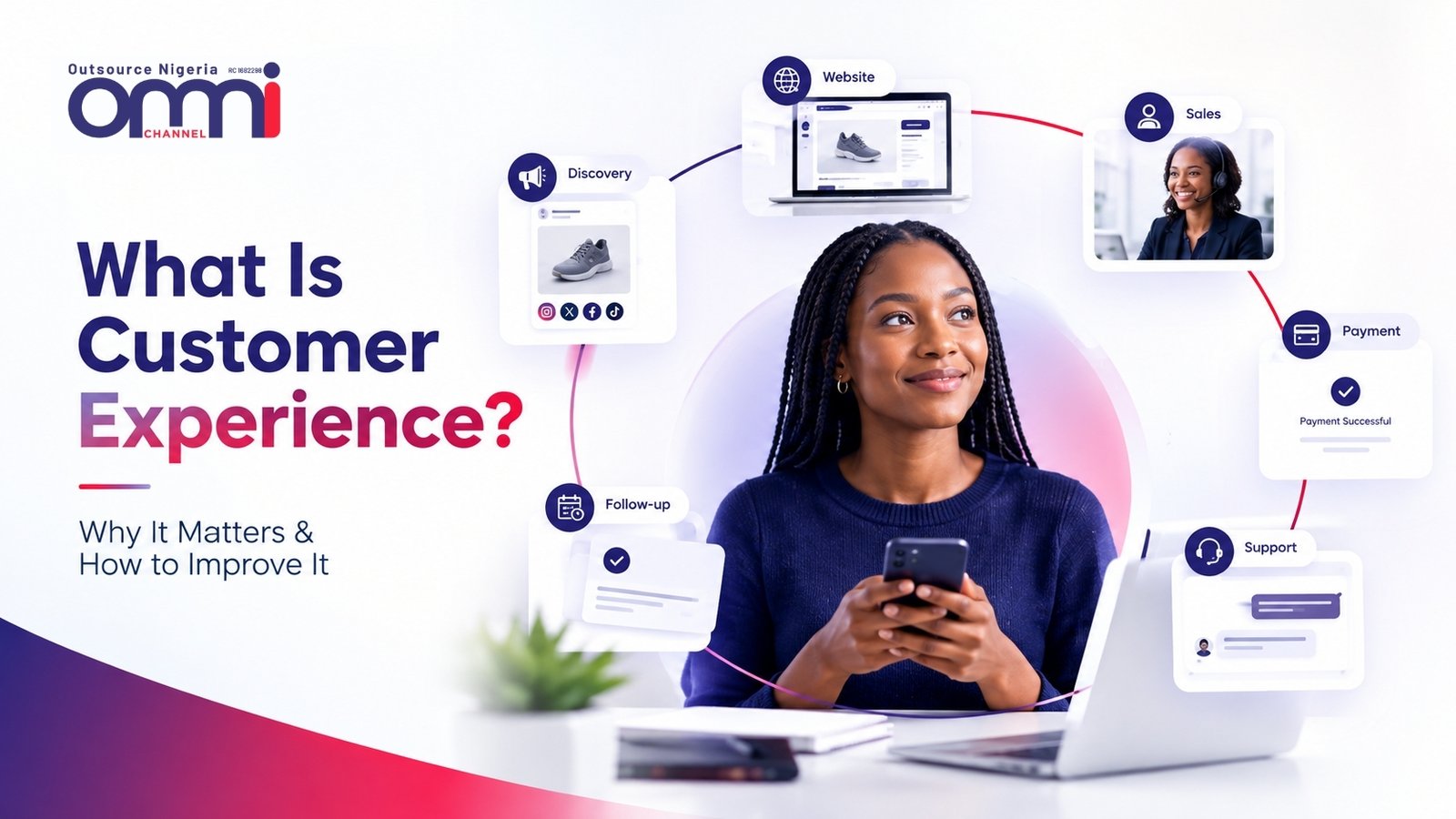
A customer’s experience can be influenced by an advertisement, website, social media page, salesperson, payment process, delivery, onboarding, product itself, support conversation, billing process or follow-up. Even the effort required to move from one stage to another becomes part of the experience.
This is why customer experience is better understood as a business system, not simply a service function.
Salesforce’s guide to customer experience similarly describes CX as the collection of interactions that shape a customer’s perception of a brand, from the first point of contact through ongoing support.
This means CX is not owned by one department.
Marketing can create an expectation. Sales can reinforce it. Operations can either deliver or undermine it. Technology can remove friction or introduce more of it. Customer service can determine what happens when something goes wrong.
The customer experiences all of these as one relationship with the company.
Customer Experience vs Customer Service
Customer service is an important part of customer experience, but the two are not the same.
Customer service generally concerns the assistance a business provides when customers have questions, problems or requests. Customer experience covers the broader relationship and the complete journey surrounding those interactions.
| Customer service | Customer experience |
| Focuses on specific customer interactions | Looks at the broader customer journey |
| Often responds to questions or problems | Includes experiences before, during and after purchase |
| Commonly involves service and support teams | Requires coordination across departments |
| Measures individual service interactions | Looks at broader perceptions, effort and outcomes |
For example, an agent might successfully resolve a customer’s complaint. That is good customer service. But if the customer had to contact the company three times, repeat their information and wait several days before reaching the right person, the overall customer experience may still be poor.
The important question is therefore not only “Did we solve the customer’s problem?” but also “How difficult did we make it for the customer to get it solved?”
Why Does Customer Experience Matter?
Customer experience matters because customers judge a business through the totality of their interactions, not through individual departments.
A strong experience can support satisfaction, trust, loyalty and continued relationships, while repeated friction can create frustration and make it harder for customers to achieve what they came to do.
The ISO 23592:2021 standard on service excellence provides principles and a model for organizations seeking to achieve outstanding customer experiences and sustainable customer delight.
But improving CX is not simply about trying to “make customers happy.”
It is about making the customer’s journey work.
That means reducing unnecessary steps, making information easier to access, keeping promises, resolving problems consistently and ensuring employees have the context they need to help customers.
The Customer Journey: Where CX Actually Happens
To improve customer experience, you first need to understand the customer journey.
A customer journey is the sequence of stages and interactions a customer experiences while moving toward a goal with a business, from becoming aware of the brand through purchase and post-purchase engagement. Salesforce’s customer journey guide explains that mapping these interactions can reveal where customers encounter friction.
A typical journey might move through awareness, consideration, purchase, onboarding, usage, support and retention.
But customers do not necessarily move through these stages in a perfectly straight line. They may discover a company on social media, visit its website, speak with sales, ask a question on WhatsApp, abandon the purchase, return weeks later and eventually contact support.
explains customer journeys as the progression of interactions customers have with a business across different stages and touchpoints.
This is where customer journey mapping becomes useful. Customer journey mapping is the process of visualizing those stages, interactions and potential friction points from the customer’s perspective.
Instead of asking, “How is our customer service performing?”, a business can ask:
Where does the customer have to work harder than necessary? or where does the customer experience friction, confusion, delay or unnecessary effort?
That question can reveal problems that departmental reports miss.
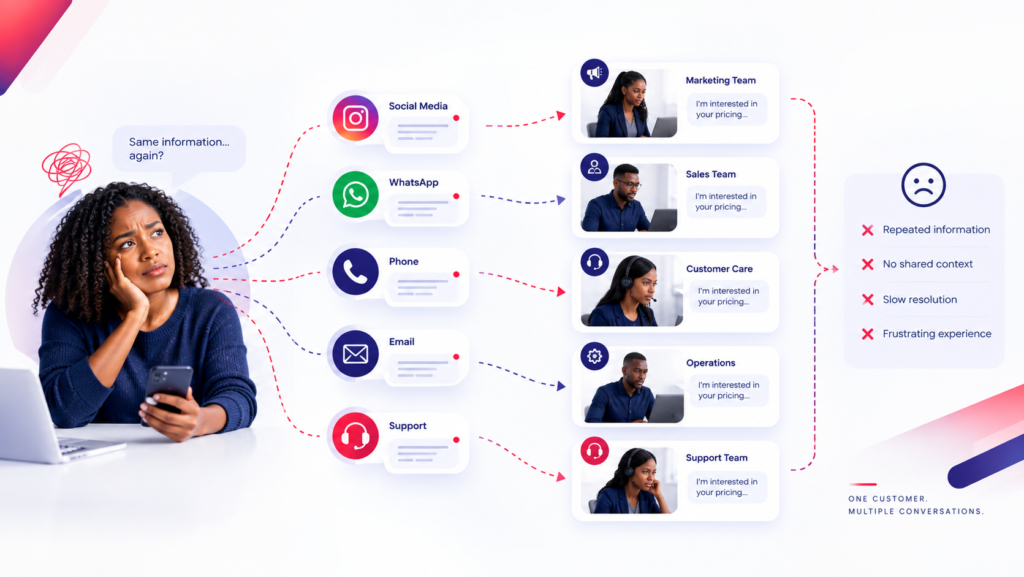
For instance, a customer might move from social media to WhatsApp, then to a phone call and finally to email. If each channel operates without shared context, the business may see four separate interactions while the customer experiences one long, frustrating conversation.
This is one reason CX problems are often visibility problems before they are communication problems. When information is scattered across channels and systems, employees may lack the context needed to provide a consistent response.
What Makes a Good Customer Experience?
Good CX is not necessarily about making every interaction impressive. Often, it is about making the customer’s goal easy to accomplish.
A useful way to think about customer experience is through three questions, based on the fundamental components of CX in Qualtrics’ experience model:
- Success: Can the customer accomplish what they came to do?
- Effort: How difficult was it to accomplish it?
- Emotion: How did the interaction make the customer feel?
These three dimensions are also reflected in .
This framework is practical because it moves the conversation beyond vague ideas about “delighting customers.”
A customer might successfully complete a purchase but have to navigate five unnecessary steps. Another might receive a fast response but feel ignored because the employee does not understand their previous interactions.
Good CX considers all three.
How Do You Measure Customer Experience?
You cannot improve every part of CX at once. Measurement helps identify where the experience is working and where customers are encountering friction.
Common CX measurements include:
- Customer Satisfaction Score (CSAT): measures how satisfied customers are with a particular interaction.
- Net Promoter Score (NPS): measures customers’ willingness to recommend a company or brand.
- Customer Effort Score (CES): examines how easy or difficult it was for customers to accomplish a task and operational measures such as response time
- Retention and churn: show whether customers continue or stop doing business with the company.
The important part is not collecting every metric available. E
ISO 10004:2018 — Quality management: Customer satisfaction provides guidance for organizations establishing processes to monitor and measure customer satisfaction.
The goal is to move from “What is our score?” to “What is causing this result, and what should we change?”
How to Improve Customer Experience
Improving CX does not always begin with buying new software.
Start by identifying the most important customer journeys and looking for friction within them. Then examine what customers need at each stage, where information is lost, where customers are forced to repeat themselves and where employees lack the tools or authority to resolve issues.
From there, businesses can improve the experience by simplifying processes, connecting customer information, training employees around the desired service standard and using customer feedback to identify recurring problems.
The principle is simple:
Find the friction first. Then decide what should change.
This prevents technology from becoming the strategy itself.
The Role of Technology in Customer Experience
Technology can make CX better, but only when it solves a real customer or operational problem.
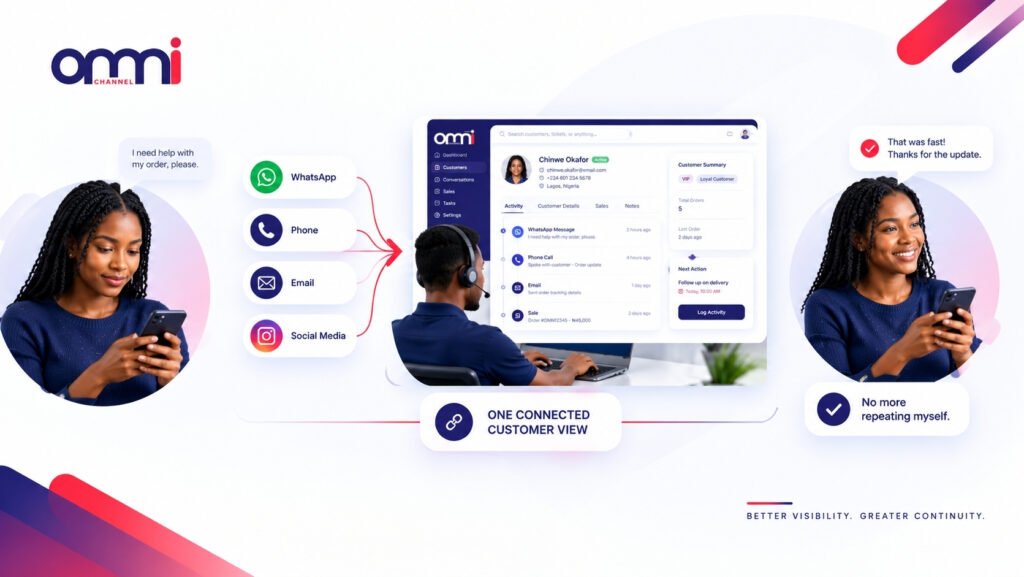
A CRM (Customer Relationship Management) system can help teams maintain customer context across interactions, giving employees a clearer view of customer information, conversations and activity. Automation can reduce repetitive work. Analytics can reveal patterns in customer behaviour. Connected communication systems can help teams manage interactions across multiple channels.
For example, Omni CRM brings customer management, sales and business operations into one connected workspace, helping businesses organise customer information and interactions instead of managing them across disconnected tools. This can be particularly useful for teams handling customer relationships across different stages of the customer journey.
But technology cannot fix a broken process simply by being added to it.
If a customer has to repeat the same information because WhatsApp, phone and email interactions are disconnected, adding another communication channel may create even more complexity.
For businesses managing multiple customer interactions, the goal should be better visibility and continuity, not simply more channels.
This is where solutions such as Omni Channel’s customer service solutions and call centre solutions, alongside CRM platforms such as Omni CRM, can become part of the operational layer behind CX. Together, these technologies can help businesses organise customer information, manage communication and create more consistent service workflows.
What Is an Omnichannel Customer Experience?
An omnichannel customer experience connects customer interactions across channels so the experience remains consistent as customers move between them.
This is different from simply offering multiple channels.
A business may have phone, WhatsApp, email, social media and live chat and still provide a fragmented experience if those channels operate independently.
Multichannel means customers have several ways to communicate with a business.
Omnichannel means those channels work together around the customer’s journey.
For example, if a customer begins a conversation on WhatsApp and later calls the business, the second interaction should ideally build on the first rather than forcing the customer to start again.
That is not merely a technology issue. It is a customer-effort issue.
Common Customer Experience Mistakes
One common mistake is treating CX as the responsibility of the customer service department alone. Because the customer’s experience crosses marketing, sales, operations, technology and support, problems often exist between departments rather than inside one department.
Another is measuring satisfaction without investigating the reasons behind it. A score can tell you that something changed; it does not automatically tell you what needs to be fixed.
A third is adding technology before understanding the problem. Businesses can end up with more platforms, more channels and more data while customers still experience the same underlying friction.
How to Build a Customer Experience Strategy
A practical customer experience strategy should begin with the customer journey rather than the technology.
Identify the journeys that matter most to the business. Map the major interactions and points of friction. Gather customer feedback alongside operational data. Then determine which problems require changes to people, processes, technology or channel design.
From there, assign ownership and measure whether the changes actually improve the customer experience.
The strongest CX strategies therefore connect four things: what customers need, how employees work, how processes operate and what technology enables.
That is also why customer experience management is a cross-functional discipline rather than a single department initiative.
The Bottom Line
Customer experience is not simply about answering customers quickly or making individual interactions pleasant.
It is the result of what happens when people, processes, technology, communication channels and customer expectations meet.
The businesses that improve CX are not necessarily the ones with the most technology or the largest customer service teams. They are the ones that understand where customers experience friction, identify why it happens and systematically make the journey easier.
Start with one important customer journey. Map what the customer has to do. Find where effort is unnecessarily high. Then fix the underlying process before deciding whether technology is needed.
If disconnected channels, slow responses or fragmented customer information are making that difficult, explore Omni Channel’s customer experience solutions or talk to the Omni Channel team about your customer operations. The goal is not simply to add another service channel. It is to build the operational foundation that helps every interaction feel like part of the same customer experience.