For many Nigerian businesses, WhatsApp is where customer relationships begin. A potential buyer sends an enquiry, asks for prices, requests more information and sometimes completes a purchase without ever visiting the company’s website.
This is hardly surprising. PwC Nigeria’s MSME Survey 2024 identifies WhatsApp Business as the most commonly reported business technology channel among its surveyed MSMEs, at 23%.
WhatsApp has become an important business communication tool. However, there is a difference between communicating with customers and managing customer relationships.
So, is WhatsApp a CRM? Not entirely. WhatsApp Business provides useful customer communication and basic organization features, but it does not replace the broader customer management capabilities of a dedicated CRM system.
For businesses receiving enquiries from multiple customers, employing sales representatives or managing several communication channels, understanding this difference can help prevent missed opportunities, inconsistent follow-ups and fragmented customer information.
What Is WhatsApp Business, and What Can It Do?
WhatsApp Business is a business-focused messaging application designed to help businesses communicate with customers more effectively.
According to Meta’s official WhatsApp Business feature documentation, the application includes several tools that make customer communication easier.
These include:
- Business profiles: Display your business name, description, operating hours and other relevant information.
- Greeting messages: Automatically welcome customers when they initiate conversations.
- Away messages: Inform customers when your business is unavailable.
- Quick replies: Save frequently used responses to answer common questions faster.
- Labels: Organize conversations into categories to make important chats easier to find.
- Broadcasts: Send business messages to multiple customers, subject to the applicable features and eligibility.
For a small business owner managing customer enquiries independently, these features can be extremely useful.
For example, a fashion retailer can use WhatsApp Business to answer questions about available sizes, share product photographs, confirm orders and provide delivery updates.
The platform makes everyday communication easier.
However, as the business grows, the challenge changes. It becomes less about sending messages and more about managing everything that happens before, during and after those conversations.
Why WhatsApp Alone May Not Be Enough to Manage Growing Customer Relationships
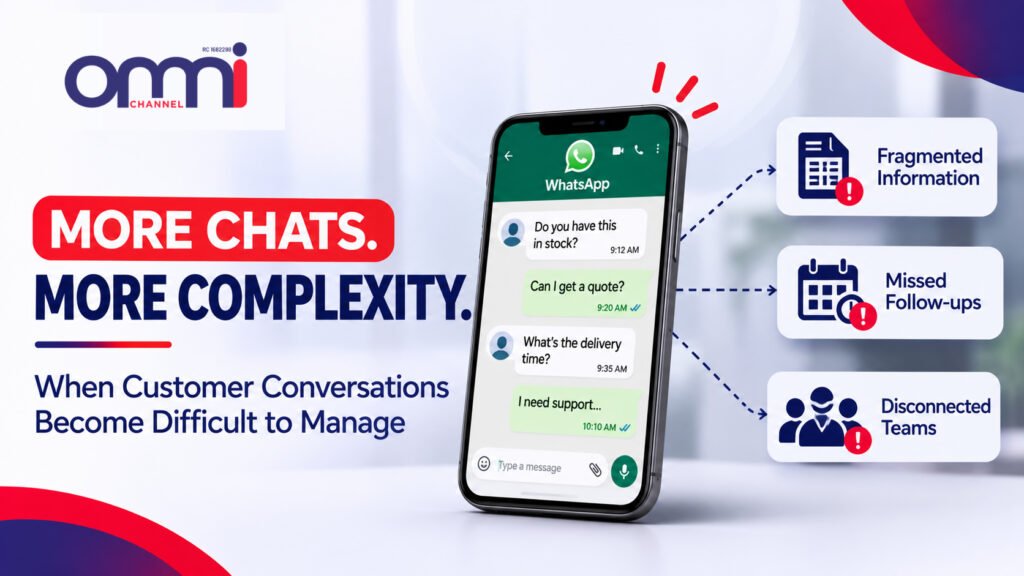
Imagine a Nigerian real estate company receiving enquiries through WhatsApp.
One customer wants to inspect an apartment. Another is negotiating the price of a property. A third has requested additional photographs, while another is waiting for a callback.
The sales team is handling several conversations simultaneously.
At first, the process may appear manageable. But what happens when the employee handling an enquiry is unavailable? Who knows which prospects have received follow-ups? Can the sales manager see which enquiries are progressing towards a purchase?
This is where relying exclusively on WhatsApp can become difficult.
1. Customer information becomes fragmented
Customer information may be scattered across individual conversations, employees’ devices, spreadsheets and other communication platforms.
An employee might remember that a customer requested a particular service, but another team member may not have access to that conversation or its history.
Without organized customer records, businesses can struggle to maintain continuity when different employees interact with the same customer.
A CRM system helps bring customer information, notes, interactions and relevant activities together in an organized profile.
2. Following up with customers becomes inconsistent
Not every customer makes a purchasing decision immediately.
Some request quotations and need time to consider their options. Others want additional information before proceeding.
When follow-ups depend entirely on employees remembering individual conversations, some prospects may receive attention while others are overlooked.
A structured customer management process makes it easier to record follow-up requirements, assign responsibility and monitor outstanding opportunities.
3. Team collaboration becomes difficult
WhatsApp conversations can become difficult to manage when several employees are responsible for customer communication.
A customer might speak with one salesperson today and contact another employee tomorrow. If the second employee cannot access the relevant interaction history, the customer may have to explain the situation again.
Businesses need a way to give relevant team members visibility into customer interactions and responsibilities.
4. Managers have limited visibility into customer engagement
A business owner may know that the company receives plenty of WhatsApp enquiries without knowing:
- How many enquiries become actual sales?
- Which prospects are still awaiting responses?
- Which sales representatives are responsible for particular opportunities?
- How many customer complaints remain unresolved?
- Which customer communication channels generate the most opportunities?
These questions require more than access to individual conversations. They require organized records, tracking and reporting.
When Should a Business Move from WhatsApp to a CRM?
A business does not need to stop using WhatsApp simply because it is growing. However, there comes a point when managing customer conversations through individual chats becomes difficult to sustain.
The decision to introduce a CRM should depend on the complexity of customer interactions, the number of people managing them and how much visibility the business needs.
Here are some signs that it may be time to move beyond WhatsApp alone:
1. You are regularly missing customer enquiries
If customers send messages but enquiries are sometimes forgotten, overlooked or answered too late, your current process may no longer be sufficient.
A CRM helps businesses record incoming leads, assign responsibility and monitor which enquiries still need attention.
2. Multiple employees handle customer conversations
When several sales representatives or customer service employees communicate with customers, relying on individual chat histories can create information gaps.
A CRM provides a shared environment where authorised team members can access relevant customer information and interaction histories.
3. You struggle to track follow-ups and potential sales
If employees depend on memory, personal reminders or scattered spreadsheets to remember which customers need attention, opportunities can easily be missed.
A CRM helps organise follow-up activities, track sales opportunities and show where each prospect is in the customer journey.
4. You cannot easily measure sales and customer engagement
If you know how many enquiries your business receives but cannot determine how many become paying customers, you may need better customer management and reporting capabilities.
A CRM can help managers monitor lead conversion, sales activities, response performance and outstanding customer requests.
5. Customers contact your business through multiple channels
When enquiries come through WhatsApp, email, social media, website forms and other channels, managing each interaction separately can make it difficult to maintain a consistent customer experience.
A CRM with suitable integrations can bring supported interactions and customer information into a more centralized workspace.
The key takeaway: You should consider moving to a CRM when managing customer relationships requires more organisation, accountability and visibility than WhatsApp Business can comfortably provide.
You can continue using WhatsApp as a communication channel while allowing a CRM to manage the wider customer relationship process.
WhatsApp Business vs CRM Software: What Is the Difference?
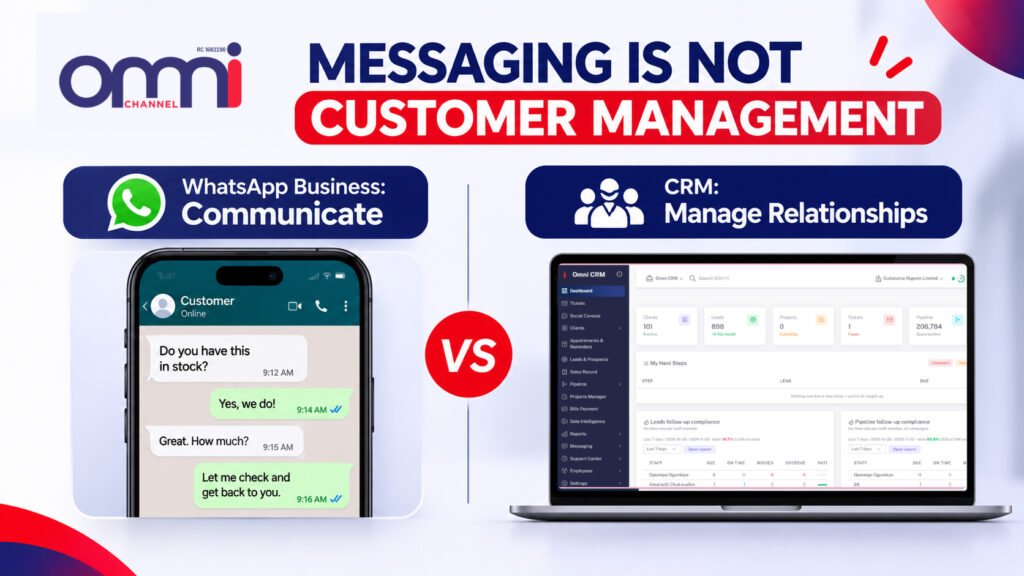
The biggest difference is their purpose.
WhatsApp Business primarily supports customer communication. CRM software supports the broader process of managing customer relationships and business interactions.
| Capability | WhatsApp Business App | Dedicated CRM |
| Sending and receiving messages | Yes | Depends on integrations and available communication features |
| Business profile | Yes | Customer and business records |
| Quick replies | Yes | Depends on the system |
| Conversation labels | Yes | Customer categorization and segmentation |
| Centralized customer records | Limited | Yes |
| Sales pipeline management | Not its primary function | Yes |
| Lead ownership and tracking | Limited | Yes |
| Follow-up management | Basic messaging tools | Structured follow-up processes |
| Team collaboration | Limited compared with a shared CRM workspace | Depends on the platform |
| Sales and performance reporting | Limited business messaging insights | Broader reporting capabilities |
This does not mean WhatsApp Business is unsuitable for businesses.
It means that businesses should recognize when their customer management requirements have grown beyond what a messaging application is designed to handle.
How Nigerian Businesses Can Manage WhatsApp Conversations Better
Businesses do not necessarily need to abandon WhatsApp to improve customer management. They need a more structured approach to handling the conversations it generates.
Here are five practical steps.
1. Organize customer information
Do not allow important customer details to exist only inside individual chat histories.
Record relevant information such as:
- Customer name and contact details.
- Product or service of interest.
- Previous enquiries.
- Purchase history, where applicable.
- Outstanding requests.
- Important communication notes.
This gives employees a better understanding of the customer before responding.
2. Assign responsibility for customer enquiries
Every serious enquiry should have someone responsible for handling it.
For example, a business receiving enquiries about different products could assign leads to relevant sales representatives.
This helps prevent situations where everyone assumes another employee is handling a particular customer.
3. Establish a consistent follow-up process
Not every customer will respond immediately or complete a purchase after the first conversation.
Businesses should establish clear follow-up procedures.
For instance:
- New enquiry received.
- Customer requirements identified.
- Relevant information or quotation shared.
- Follow-up scheduled.
- Customer decision recorded.
- Opportunity marked as won, lost or still in progress.
This creates a more consistent process for managing potential customers.
4. Bring customer conversations into a shared workspace
When multiple employees handle customer communication, businesses should consider tools that allow relevant team members to access conversation histories and customer information.
This reduces dependence on individual employees’ devices and makes it easier to maintain continuity when responsibilities change.
5. Monitor customer engagement and sales activities
Businesses should regularly assess their customer management processes.
Useful indicators include:
- Number of incoming enquiries.
- Response times.
- Outstanding follow-ups.
- Leads converted into customers.
- Unresolved customer requests.
- Sales activities by team members.
These insights help managers identify where their processes need improvement.
How CRM Software and WhatsApp Work Together
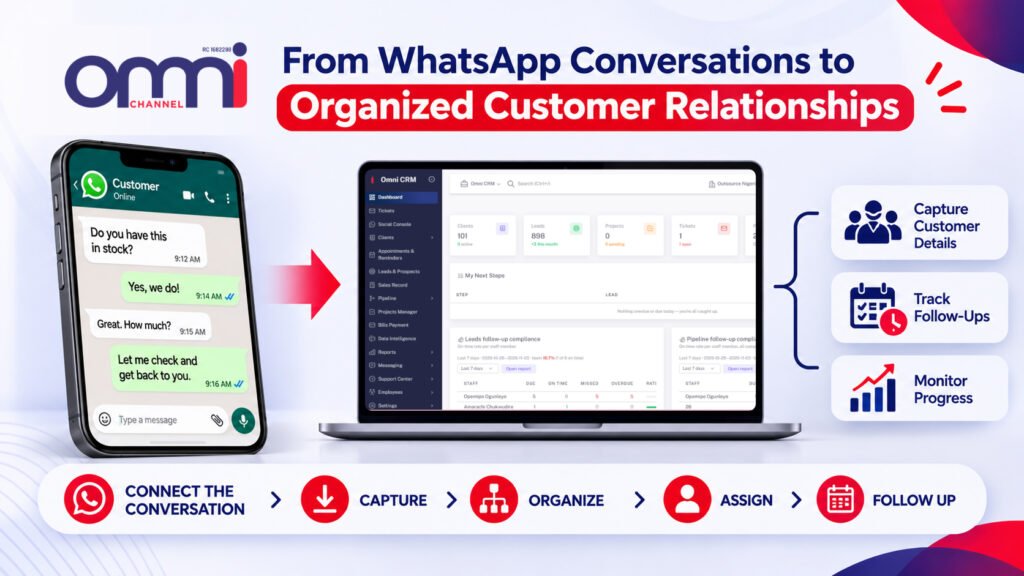
A CRM integrated with WhatsApp can help businesses move beyond managing isolated conversations.
Instead of treating every message as a separate interaction, the business can connect conversations to customer records and related sales or support activities.
For example, consider a Nigerian ecommerce company receiving enquiries through WhatsApp, Instagram and its website.
A customer asks about a product through WhatsApp. The sales representative responds, records the customer’s interest and tracks the opportunity. If the customer later contacts the business through another supported channel, the team can use the available customer history to understand the previous interaction.
This approach helps create a more connected customer management process.
It is also important to distinguish between WhatsApp Business and the WhatsApp Business Platform (API). Meta provides the API for businesses that need more scalable messaging capabilities and integrations. Businesses should check the applicable messaging policies, customer opt-in requirements and integration arrangements before implementing such a solution.
Manage WhatsApp Conversations Better with Omni CRM
For businesses that have outgrown managing customer conversations through individual WhatsApp chats, a more centralized CRM environment can make a meaningful difference.
Omni CRM by Omni Channel is designed to bring customer management, communication, sales activities and team collaboration into one business platform.
Its messaging and communication capabilities are particularly relevant to businesses that want to manage customer interactions across different channels.
With Omni CRM, businesses can:
Centralize customer conversations: The messaging solution brings supported communication channels, including WhatsApp, email, SMS, live chat and social direct messages, into a shared workspace.
Maintain customer interaction histories: Conversations can be logged against customer profiles, helping team members understand previous interactions.
Coordinate customer enquiries: Shared inbox and routing capabilities help direct incoming messages to relevant team members or departments.
Manage follow-ups: Communication workflows support scheduled follow-ups, reminders and customer re-engagement activities.
Improve customer visibility: Customer management provides organized contact profiles, communication histories, notes and deal information.
Monitor communication activities: Reporting capabilities help businesses examine messaging and team engagement activities.
These capabilities address an important operational challenge: customer conversations should not remain isolated inside individual communication channels when multiple employees are responsible for managing relationships.
You can explore Omni CRM’s messaging and communication capabilities and its customer management features.
Note: WhatsApp Business API access is listed as a separately priced add-on on the current Omni CRM pricing page. Availability and applicable subscription requirements should be confirmed before implementation.
Conclusion: WhatsApp Starts the Conversation, but CRM Helps Manage the Relationship
WhatsApp is an important communication tool for Nigerian businesses. It makes it easier to answer enquiries, share information, communicate with customers and support everyday business activities.
But managing customer relationships involves more than exchanging messages.
Businesses also need organized customer records, consistent follow-ups, clear employee responsibilities, sales visibility and coordinated customer support.
The objective is not to replace WhatsApp. It is to make sure that valuable customer conversations lead to organized, trackable business activities.
If your business is receiving more enquiries, employing more customer-facing staff or managing conversations across multiple channels, it may be time to consider a dedicated CRM system.
Want to see how your business can manage customer conversations, sales activities and customer relationships in one place? Book a personalized Omni CRM demo and explore what the platform can do for your team.